
By Ben Read — former wedding cinematographer, 150+ weddings filmed, and successful entrepreneur. Last updated July 2026.
This comparison is published by WeddingBills. I've worked weddings from the vendor side for years, and I've tried to represent Aisle Planner fairly — pricing and fees were verified as of last update, but always check each provider's own site for the latest.
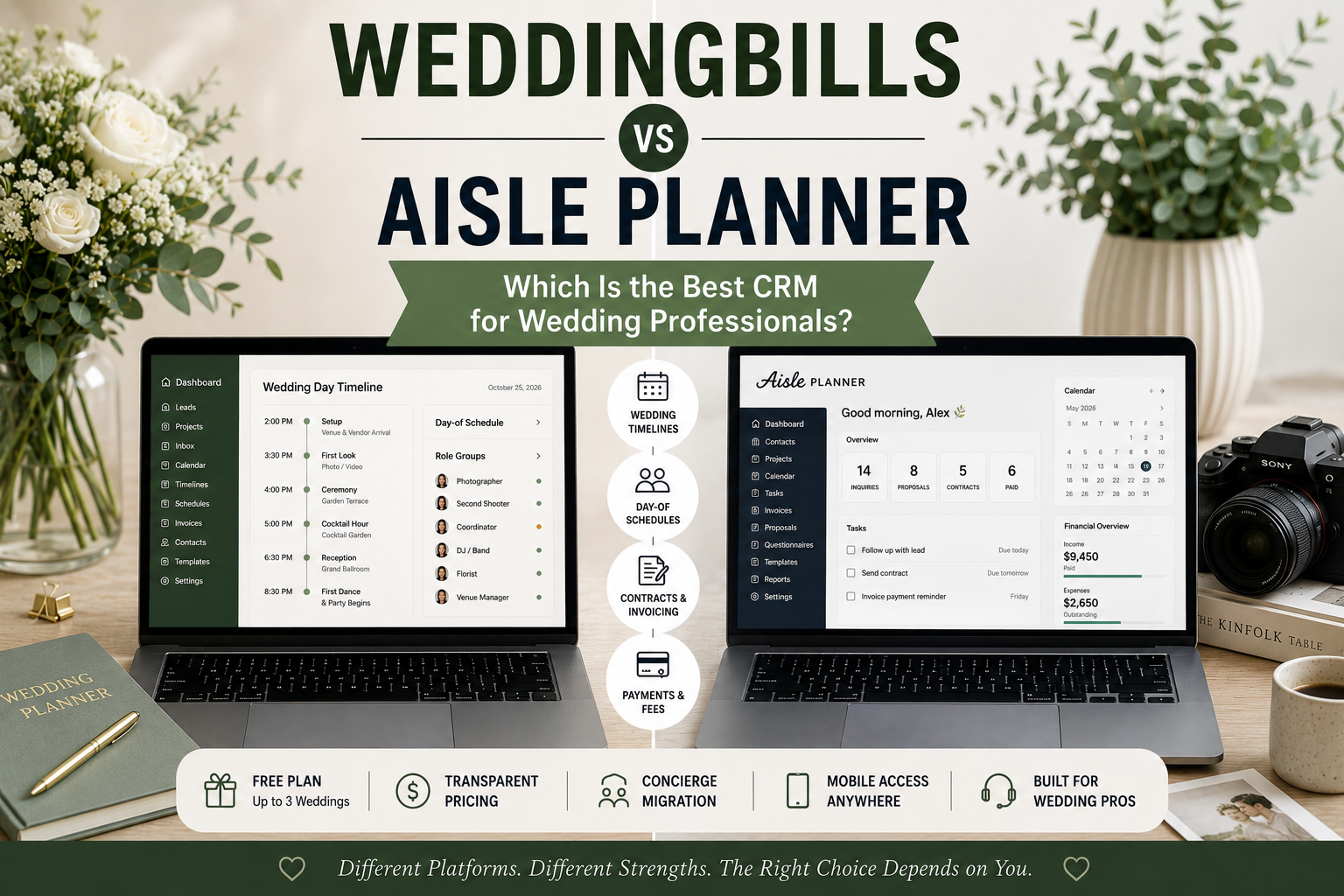
Short answer: These are the two most wedding-native platforms on the market, and they overlap more than any other pairing in this space — both handle CRM, contracts, e-signatures, invoicing, payments, and timelines. So the "we're built for weddings" line I'd use against a general CRM doesn't apply here; Aisle Planner is built for weddings too. The real decision is depth versus focus. Aisle Planner is the more complete planning studio — it has the guest lists, seating charts, and mood boards WeddingBills doesn't. WeddingBills is the leaner, automation-forward business platform, with a fuller CRM, deep customizable workflows, built-in scheduling, modern integrations, and a genuinely free way to start — and it's built for all wedding pros, not only planners. Which one wins depends entirely on where your work actually lives.
Are WeddingBills and Aisle Planner really alternatives?
Partly. They're alternatives for the business side of running a wedding company — leads, booking, contracts, invoicing, payments, and client communication — where they cover much of the same ground, though WeddingBills' CRM and automation run deeper. They're not straight substitutes on the planning side: Aisle Planner includes a full suite of hands-on planning and design tools that WeddingBills doesn't try to replicate. So the honest way to frame this isn't "which is better," it's "which half of the job matters more to you." The rest of this page is about answering that.
WeddingBills vs Aisle Planner at a glance
Where Aisle Planner leads: the planning studio
I'll start here, because it's the clearest and most important difference, and it favors Aisle Planner.
Aisle Planner is one of the most complete wedding-planning toolsets on the market, and it earns that reputation. Beyond the business basics, it gives you drag-and-drop seating and floor-plan tools, full guest list management, a design studio for mood boards and inspiration galleries, and deep checklist and vendor-management features — all wedding-specific, all in one place. For a full-service planner or designer whose day-to-day revolves around laying out a reception, wrangling a guest list, and building a visual concept with a couple, that depth is genuinely valuable, and WeddingBills doesn't match it.
WeddingBills deliberately doesn't try to. It has event timelines and day-of schedules with role groups, but it does not include guest lists, seating charts, or a mood-board studio. If those live at the center of how you plan, that's a real point for Aisle Planner, full stop.
Where WeddingBills leads: CRM depth, automation, and reach
WeddingBills' strengths sit on the business-operations and automation side.
- A fuller business CRM. WeddingBills leads with a complete CRM and lead pipeline for managing inquiries, bookings, and client relationships as a business. Aisle Planner has lead-management tools, but they're the lighter, more planning-oriented part of the platform — its users regularly ask for stronger lead management, batch email, and team messaging. If running the business side is a priority, WeddingBills' CRM goes deeper.
- Built for all wedding pros, not just planners. Aisle Planner is planner-centric by design: its core tooling — seating charts, guest lists, the design studio — is built around the planner/designer workflow, which is more than a photographer or florist needs. WeddingBills is built for the full range of wedding professionals, so the same platform fits a planner, a photographer, and a florist alike.
- Deep, customizable workflow automation. WeddingBills' automation engine is built to run your client lifecycle end to end — with wedding-specific workflows already in place and full room to customize — which is more automation-forward than Aisle Planner's planning-oriented approach.
- Modern integrations. WeddingBills connects to Gmail, Google Calendar, and Zapier — and Zapier bridges to thousands of other apps. Aisle Planner is a more closed ecosystem with limited outside integrations.
- A genuinely free start. WeddingBills has a free plan for up to three active weddings. Aisle Planner has a 30-day trial but no ongoing free tier — you're on a paid plan from day one after it ends.
- Done-for-you migration. WeddingBills offers concierge migration; moving in is handled for you.
Where they overlap
For a big part of the job, these two are close. Both give you client and lead management, proposals, contracts with e-signatures, invoicing, online payments, wedding timelines, budget tracking, and a client portal — though, as noted above, WeddingBills' CRM side runs deeper. Both are cloud-based and accessible across devices, and both are built specifically for the wedding and event industry rather than adapted from a generic tool. If your shortlist is down to these two, you're not choosing between "wedding-native" and "not" — you're choosing between two wedding-native platforms with different centers of gravity.
Pricing and plans
The pricing models are structured differently, and the honest read depends heavily on your volume.
Aisle Planner prices by active project count, with every plan getting the full feature set. As of its 2026 pricing, that runs roughly $39.99/month for 10 active projects, $69.99 for 25, $99.99 for 45, and up to $169.99 for 100, with extra team seats around $10/month each. There's a 30-day free trial but no free plan. The trade-off people note: because the bill scales with active projects, a strong year costs more than a slow one.
WeddingBills prices by concurrent active weddings — a client with an open contract or project and a future event date. It starts at $0 for up to three active weddings, then $49 (5), $99 (15), and $199 (30), with a per-wedding rate above your plan's ceiling.
Here's the honest comparison: if you're just starting or run only a handful of concurrent weddings, WeddingBills is cheaper — its free tier is $0 against Aisle Planner's $39.99/month floor. But as your concurrent load grows, Aisle Planner's per-project pricing often comes out lower: a planner juggling 25 active projects sits around $69.99/month on Aisle Planner, where the same concurrent volume costs more on WeddingBills. Run both against your own realistic concurrent-wedding count before deciding — this is one place where the "obvious" cheaper option flips depending on your size.
Which type of planner is each best for?
- Aisle Planner is the better fit if hands-on planning and design are central to your work — you need guest lists, seating and floor plans, and mood boards in one place — or you run enough concurrent weddings that per-project pricing is economical, and you want the deepest wedding-planning toolset available.
- WeddingBills is the better fit if you want a fuller business CRM and automation-forward platform with built-in scheduling and modern integrations, you're a photographer, florist, or other wedding pro rather than only a planner, your detailed design and guest work happens elsewhere (or isn't central to your services), you're newer or lower-volume and want a free way to start, or you'd like migration handled for you.
Plenty of planners could run their business happily on either. The deciding question is whether you're buying a planning studio or a business operations platform — Aisle Planner leans toward the first, WeddingBills toward the second.
Switching between the two
If you're moving from Aisle Planner to WeddingBills, concierge migration means the team brings your clients and projects over for you rather than leaving you to rebuild by hand. Aisle Planner, for its part, lets you export your couple information, vendor contacts, and timeline data if you're going the other way. Either direction, be realistic about the planning-tool gap: if you rely on Aisle Planner's seating charts, guest lists, or design studio, confirm how you'll handle those before you move, because WeddingBills won't replace them.
The bottom line
Aisle Planner and WeddingBills are both genuinely built for weddings, which makes this a closer call than most comparisons. Aisle Planner is the more complete planning studio and can be the more economical choice at higher volume. WeddingBills is the leaner, automation-forward platform — with a fuller CRM, built-in scheduling, modern integrations, and a free on-ramp — and it serves every kind of wedding pro, not only planners. Pick based on where your real work lives — designing events, or running the business around them.
Want to try the automation-forward side without paying to start? Start free on WeddingBills →7-day Trial for paid plans — the Free plan covers your first three weddings.
FAQ
Is WeddingBills a good alternative to Aisle Planner?For the business side of a wedding company — CRM, contracts, invoicing, payments, timelines, budgets, and automation — yes. For hands-on planning and design, it's a partial alternative at best: WeddingBills doesn't include Aisle Planner's guest lists, seating charts, or mood boards.
What does Aisle Planner have that WeddingBills doesn't?Aisle Planner includes a fuller planning-and-design toolset: guest list management, drag-and-drop seating and floor plans, and a design/mood-board studio. WeddingBills focuses on business operations and automation instead.
What does WeddingBills have that Aisle Planner doesn't?WeddingBills offers a fuller business CRM and lead pipeline, deeper and more customizable workflow automation, built-in appointment scheduling, integrations with Gmail, Google Calendar, and Zapier, and a genuinely free plan. It's also built for all wedding professionals — planners, photographers, florists, and more — where Aisle Planner is centered on the planner/designer workflow. Aisle Planner has no free tier and more limited scheduling and integrations.
Is WeddingBills or Aisle Planner cheaper?It depends on your volume. WeddingBills is cheaper at low volume because of its free plan (Aisle Planner starts at about $39.99/month with no free tier). But Aisle Planner's per-project pricing often comes out lower as your concurrent wedding count grows. Compare both against your own numbers.
Can I switch from Aisle Planner to WeddingBills?Yes. WeddingBills offers concierge migration to bring your clients and projects across. Just plan ahead for any Aisle Planner planning tools you rely on — like seating charts or guest lists — since WeddingBills doesn't replace those.
Which is better for a full-service wedding planner?If your services center on event design and guest logistics, Aisle Planner's planning studio likely serves you better. If you want business automation, scheduling, and integrations — and handle detailed design separately — WeddingBills is the stronger fit, and it's free to start.



.jpg)
.jpg)
.jpg)






.png)

