
By Ben Read — former wedding cinematographer, 150+ weddings filmed, and successful entrepreneur. Last updated July 2026.
This comparison is published by WeddingBills. I've worked weddings from the vendor side for years, and I've tried to represent Dubsado fairly — pricing and fees were verified as of last update, but always check each provider's own site for the latest.
Short answer: Both platforms have genuinely powerful workflow automation — WeddingBills matches Dubsado on that front. The difference is what you start with and what it's built around. Dubsado is an industry-agnostic system you configure from a blank canvas, which often takes weeks. WeddingBills ships with wedding- and event-specific workflows already built in, lets you customize above and beyond them, and adds tools for the wedding day itself — so you get comparable automation power without the multi-week build, plus a free way to start. If you run a wedding or event business, that head start is the whole point.
Is WeddingBills a good alternative to Dubsado for wedding planners?
Yes — especially if Dubsado's setup has been sitting on your to-do list for a month. Both platforms cover the business essentials: leads, proposals, contracts, invoicing, payments, scheduling, and a client portal, and both have powerful workflow automation. The differences come down to three things: how long it takes to get running, whether the software understands a wedding day, and how you like to pay. Dubsado is built for service businesses of every kind and starts from a blank canvas. WeddingBills is built only for wedding and event pros, with equally capable workflows already in place, so it's usable on day one.
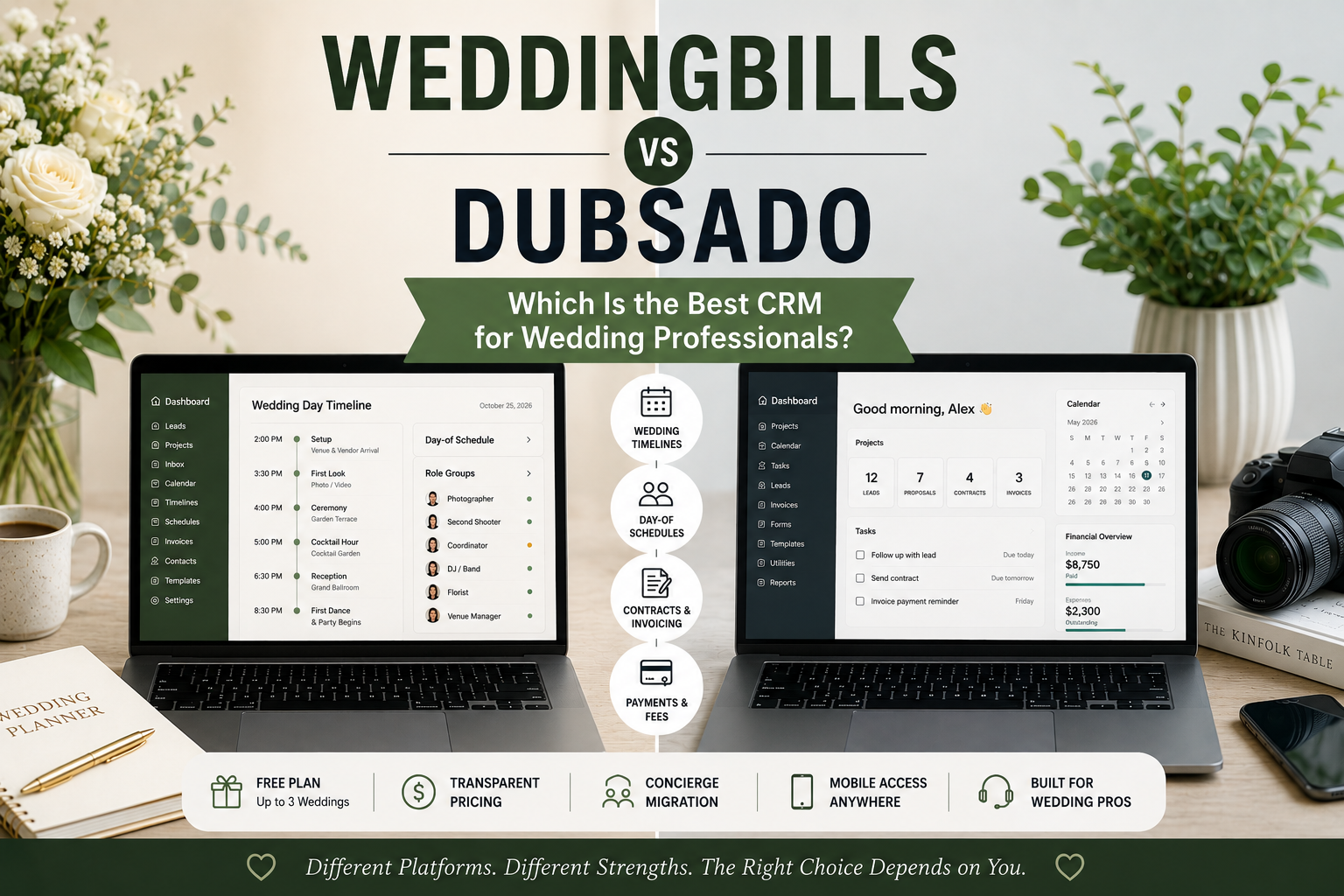
WeddingBills vs Dubsado at a glance
Setup time and the learning curve — where the real difference is
Here's the honest heart of this comparison.
Dubsado is genuinely powerful, and that power has a price: time. Its automation is deep enough that a small industry of "Dubsado specialists" exists just to set it up for people, and setup regularly stretches into weeks. Even in favorable hands-on reviews, building out the automation properly takes around a week of configuration before it's running smoothly. The payoff is real once it's done — but that first week is the reason a lot of Dubsado accounts sit half-finished.
WeddingBills takes the opposite approach. Because it's built for one industry — weddings and events — it arrives already shaped around how those businesses actually work, with native workflows in place from the start. You're not trading away power or customization to get there: the automation is just as capable and just as tunable, you simply begin from wedding-ready workflows instead of a blank page. For a planner in the middle of a busy season, that head start is usually the difference between software that's running and software that's still "almost set up."
If you run a non-wedding business, or you simply enjoy building every workflow from a blank canvas across any industry, Dubsado's open-ended flexibility is a genuine draw. If your business is weddings or events, starting from workflows built for it gets you to the same place faster. Know which kind of business you're running before you choose.
Workflow automation: the same power, pre-built for weddings
On raw workflow power, these two are evenly matched. WeddingBills' automation engine is as capable as Dubsado's, and it lets you customize as deeply as you want. What's different is your starting point.
Dubsado is industry-agnostic: it can model almost any service business's workflow, but you build those workflows yourself from an empty canvas. Its Flows builder chains triggers across the entire client lifecycle — send a contract when a form is submitted, generate an invoice when it's signed, book a kickoff call automatically — and it does that well. The cost is the configuration time.
WeddingBills gives you the same kind of trigger-based automation, but ships with wedding- and event-specific workflows already built in — the sequences a wedding business actually runs, ready on day one — and then lets you customize above and beyond them. You're not giving up power or flexibility to skip the setup; you're starting from workflows designed for your industry instead of a blank page.
The practical upshot: with Dubsado you build your automation and then run your business; with WeddingBills you run your business from day one and refine the automation as you go. Worth noting, too, that Dubsado's automation, scheduling, and Zapier access all live on its Premier plan, not the cheaper Starter tier.
Features built for weddings
This is where the platforms genuinely diverge, and where WeddingBills answers a need Dubsado doesn't.
Dubsado, like most creative CRMs, manages the business around your work but has no concept of a wedding day. WeddingBills does. You get event timelines and day-of schedules with roles and role groups — assign specific people and teams to each moment of the day, so the second shooter, the coordinator, and the setup crew each see their part of the run-of-show, all attached to the same client record as the contract and the invoice.
A fair caveat, the same one I'd give about any tool here: WeddingBills focuses on the vendor's workflow and day-of coordination, not couple-facing guest lists or seating charts. If you need full guest management, you'll pair either platform with a dedicated planning app.
How payments and fees compare
I'll be straight with you: on payment processing cost, Dubsado has the edge, and I'm not going to pretend otherwise.
Dubsado runs payments through Stripe (as "Dubsado Payments"), plus Square and PayPal, and Dubsado adds no transaction fee of its own on top of the processor's standard rate (roughly 2.9% + 30¢ for cards). Its ACH option is also capped, which is a real saving on high-ticket invoices.
WeddingBills also runs on Stripe, settling to your own Stripe account, but adds a flat 1% WeddingBills fee on top of Stripe's rate. So on raw processing cost, WeddingBills is the more expensive of the two per transaction. What you get for that is the same Stripe portability Dubsado offers, plus a single, transparent, flat 1% you can reason about — but if lowest-possible card cost is your deciding factor, Dubsado wins this round. Credit where it's due.
Pricing and plans
The pricing structures tell different stories depending on where you are in your business.
Dubsado has no free plan. It offers a free trial (Dubsado lists 21 days of full Premier access, no credit card), after which you're on a paid plan from day one. As of its December 2025 update, Starter runs about $35/month ($335/year) and Premier about $55/month ($525/year). The catch worth knowing: the Starter plan excludes scheduling, workflows, and Zapier, so for most wedding pros who want automation, Premier is effectively the real entry price. Extra brands and additional users add to the bill on top.
WeddingBills starts at $0. Plans are based on how many active weddings you're managing at once — a client with an open contract or project and a future event date. The Free plan covers up to three active weddings, which is a genuine place to run a new business from, not a countdown trial. Paid tiers raise that ceiling (Starter 5, Growth 15, Pro 30), and automation and scheduling are included rather than gated to the top plan.
The honest summary: if you want serious automation, Dubsado's real cost is Premier, and there's no free tier to grow from. WeddingBills lets you start free and includes automation and scheduling in its paid plans — though Dubsado's lower per-transaction processing may narrow the gap for high-volume, high-ticket businesses. Run both against your own numbers.
Where Dubsado is the better choice
A fair comparison names where the other tool wins, and Dubsado wins in several real places:
- Industry-agnostic flexibility. WeddingBills is optimized for wedding and event businesses. If you run a different kind of service business — or several unrelated ones — Dubsado's blank-canvas, any-industry approach fits where WeddingBills' wedding-and-event focus wouldn't.
- Lower payment processing cost. No added platform fee on top of Stripe, plus a capped ACH option.
- Multi-brand and white-labeling. If you run more than one business under one roof, Dubsado's multi-brand support and brand control are more mature.
If those are your priorities — especially running a non-wedding business or multiple brands — Dubsado is an excellent, deservedly popular platform. WeddingBills is the better fit when you want equally powerful automation that arrives pre-built for weddings, plus day-of tools, fast setup, and a free starting point.
Switching from Dubsado to WeddingBills
The honest reason people stay on Dubsado after they've outgrown it is the sunk cost: all those forms, templates, and workflows took real time to build, and rebuilding them elsewhere sounds exhausting. WeddingBills offers concierge migration — we move you over rather than handing you an export file and wishing you luck — so that first week you spent configuring Dubsado isn't a reason to stay stuck.
Which should you choose?
- Choose WeddingBills if you want software built around the wedding day (timelines, day-of schedules with role groups), you'd rather be running today than configuring for weeks, you want equally powerful automation that comes pre-built for weddings (with scheduling included), and you'd like to start free or have migration handled for you.
- Choose Dubsado if you run a non-wedding service business — or several unrelated ones — that needs an industry-agnostic system, you want the lowest payment processing cost, or you run multiple brands and need mature white-labeling.
For most wedding pros, the deciding question is simple: do you want a platform you configure into shape, or one that already understands weddings and gets out of your way? Answer honestly, and the choice makes itself.
Ready to skip the multi-week setup? Start free on WeddingBills →7-day Trial for paid plans — the Free plan covers your first three weddings.
FAQ
Is WeddingBills a good alternative to Dubsado for wedding planners?Yes. WeddingBills covers the same essentials as Dubsado — leads, contracts, invoicing, payments, scheduling, and a client portal — but is built specifically for weddings and is designed to work out of the box, without Dubsado's lengthy setup. It also adds wedding day-of tools Dubsado lacks.
Is WeddingBills easier to set up than Dubsado?Generally yes. Dubsado's automation is powerful but has a steep learning curve, and full setup often takes a week or more. WeddingBills comes pre-shaped for wedding businesses, so there's much less to configure before you can start working.
Does WeddingBills have automation like Dubsado?Yes — and it's just as powerful. WeddingBills' workflow automation matches Dubsado's capability and customization, with the added advantage that wedding- and event-specific workflows come pre-built, so you're not configuring from scratch. Dubsado's automation is comparably deep but industry-agnostic, and it lives on its Premier plan.
Is Dubsado or WeddingBills cheaper?It depends. WeddingBills has a free plan and includes automation in its paid tiers; Dubsado has no free plan and gates automation to Premier (about $55/month). On payment processing, Dubsado is cheaper — it adds no fee on top of Stripe, while WeddingBills adds 1%. Compare both against your volume.
Can I move my data from Dubsado to WeddingBills?Yes. WeddingBills offers concierge migration, where the team moves your clients and projects over for you rather than making you rebuild everything by hand.
Which is better for a wedding planner specifically?For wedding-specific work, WeddingBills has the edge: its automation is as powerful as Dubsado's but comes pre-built for weddings, and it adds day-of timelines and role-based schedules Dubsado doesn't offer. Dubsado may still suit someone running a non-wedding business, multiple brands, or who wants the lowest processing cost.



.jpg)
.jpg)
.jpg)






.png)

