
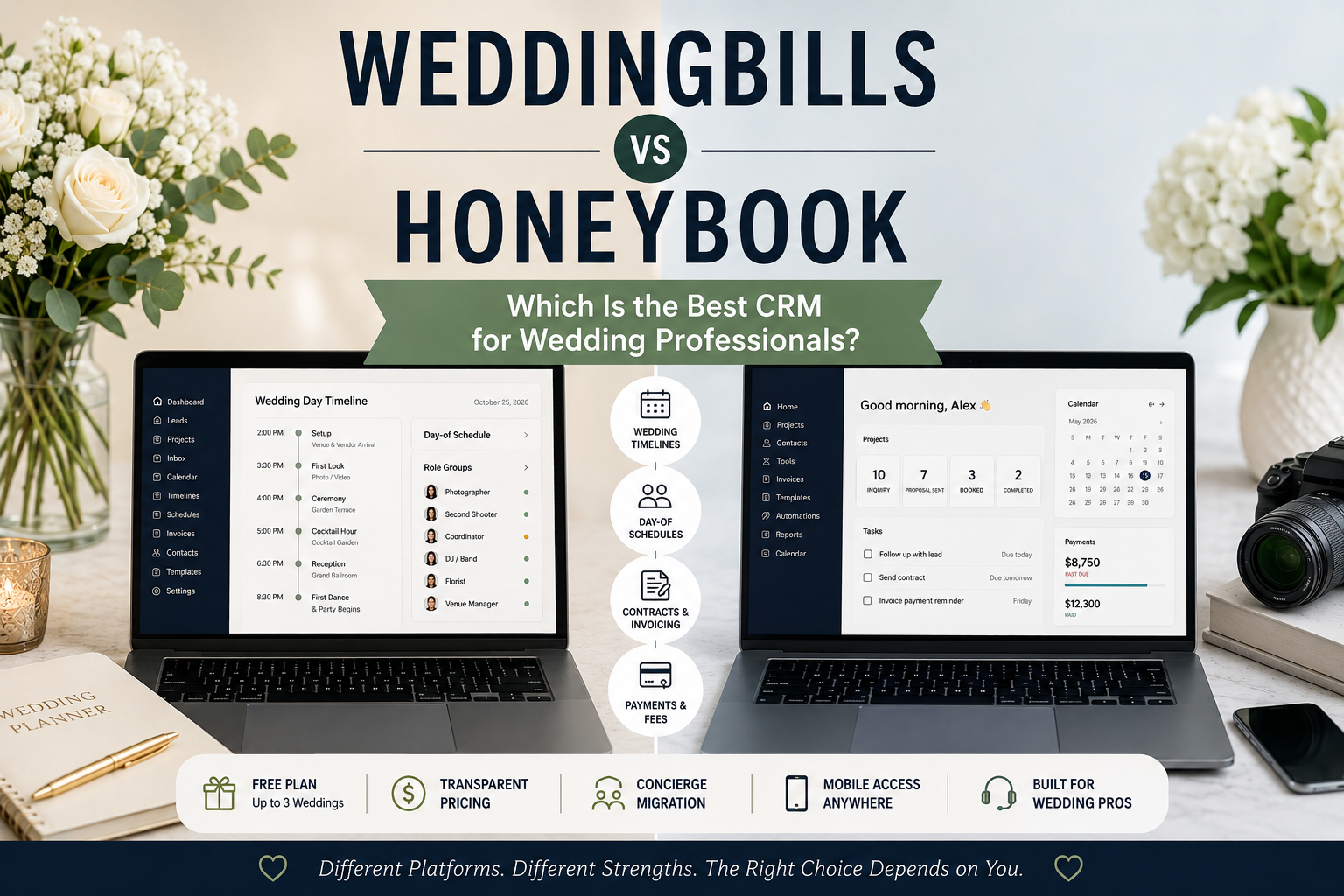
By Ben Read — former wedding cinematographer, 150+ weddings filmed, and successful entrepreneur. Last updated July 2026.
This comparison is published by WeddingBills. I've worked weddings from the vendor side for years, and I've tried to represent HoneyBook fairly — pricing and fees were verified as of last update, but always check each provider's own site for the latest.
Short answer: If you run a wedding business and want software built around the way weddings actually work — event timelines, day-of schedules, and the coordination that happens on the wedding day — WeddingBills is the closer fit, and it has a free plan you can start on today. If your priority is a polished, plug-and-play client experience with a strong mobile app and lots of integrations, HoneyBook is the more mature, more established choice. Below is the honest breakdown.
Is WeddingBills a good HoneyBook alternative for wedding planners?
Yes — for planners specifically, WeddingBills is a genuine alternative, because it's built only for wedding professionals. HoneyBook is an excellent all-purpose client platform for creatives of every kind — photographers, designers, coaches, consultants — but that breadth is also the trade-off: it isn't shaped around a wedding day. WeddingBills covers the same business essentials (leads, contracts, invoicing, payments) and adds the wedding-specific tools HoneyBook doesn't have. Whether it's the better choice depends on what you value most, which is what the rest of this page is for.
WeddingBills vs HoneyBook at a glance
Built for weddings: timelines and day-of schedules
This is the real difference, so it's worth being specific about.
HoneyBook manages the business around your work beautifully — inquiry, proposal, contract, invoice, payment — but it stops at the office door. It has no concept of a wedding day. WeddingBills does. You get event timelines and, critically, day-of schedules with roles and role groups, so you can assign specific people and teams to each moment of the day: who's setting up at 2:00, which second shooter covers the first look, when the coordinator hands off to the band. Everyone sees their part of the run-of-show.
If you've ever tried to force a generic CRM to hold a wedding timeline — I have — you know it ends up living in a separate spreadsheet or planning app, disconnected from the client record. Keeping the day-of plan in the same place as the contract, the invoice, and the client conversation is the practical reason a wedding-native tool earns its place.
A fair caveat: WeddingBills is focused on the vendor's workflow and day-of coordination, not couple-facing guest lists or seating charts. Neither platform is a guest-management tool, so if that's a core need, you'll want a dedicated planning app alongside either one.
How payments and fees compare
Both platforms let your clients pay by card or bank transfer, and both fold payments into your invoices. The difference is in how — and I want to be straight with you here, because this is where a lot of comparison pages overreach.
HoneyBook is its own payment processor. Standard entered-card payments run 2.9% + 25¢, card-on-file and autopay run a higher 3.4% + 9¢, and ACH bank transfers are 1.5%. That standard card rate is competitive with the wider industry. The trade-offs are that you can't bring your own processor (no Stripe, Square, or PayPal), the card-on-file surcharge catches some people off guard, and there's an optional 1% fee if you want instant deposits.
WeddingBills runs on Stripe, settling to your own Stripe account, with a flat 1% WeddingBills fee on top of Stripe's published rate. In plain terms, that means your effective card cost is a little higher than HoneyBook's standard entered-card rate, not lower — so we're not going to pretend payments are cheaper here.
What WeddingBills payments do give you is transparency and portability: one clear, flat 1% on top of a rate you can look up on Stripe's own site, money landing in a Stripe account that's yours to keep, and no closed processor you're locked into. If you already use Stripe, or you value being able to walk away with your payment history intact, that matters. If you simply want the lowest per-transaction card cost, HoneyBook's standard rate has the edge. Both are legitimate priorities — pick the one that's yours.
Pricing and plans
Here the structures differ in a way that genuinely favors newer and lower-volume planners.
HoneyBook has no free plan. After a free trial, plans start at $29/month billed annually ($36 monthly), rising to $49 and $109 for Essentials and Premium — and note that automation lives on Essentials and up, while team access is gated to the top Premium plan. HoneyBook also raised prices substantially in early 2025, with the Starter tier jumping roughly 89%.
WeddingBills starts at $0. Plans are based on how many active weddings you're managing at once — an active wedding being any client with an open contract or project and a future event date. The Free plan covers up to three active weddings, which is a real place to run a new business from, not a countdown trial. Paid tiers raise that ceiling (Starter 5, Growth 15, Pro 30, with a low per-wedding rate above your plan's limit), so what you pay tracks how much live work you're actually carrying — not a flat fee you owe in the slow months too.
The honest summary: if you're new, seasonal, or carrying only a handful of live weddings at a time, WeddingBills is dramatically cheaper — and because billing follows your concurrent load, it eases off in quieter stretches rather than charging a flat rate year-round. At high, steady volume the two get closer, so run your own numbers against how many weddings you typically manage at once. But the free entry point is a real advantage HoneyBook doesn't offer at all.
Where HoneyBook is the better choice
A fair comparison names where the other tool wins, and HoneyBook wins in a few real places.
- A dedicated mobile app. WeddingBills is fully mobile-responsive, so you can run it from your phone's browser — on-site at a venue or replying to inquiries between meetings. But HoneyBook goes a step further with native iOS and Android apps: home-screen access, push notifications, and the smoother feel of a purpose-built app. If working from your phone is central to how you operate, that native experience is still an edge for HoneyBook.
- Integrations. WeddingBills covers the essentials — Gmail, Google Calendar, and Zapier, which bridges to thousands of other apps — but HoneyBook offers a broader set of native integrations, including direct QuickBooks accounting sync. If your stack leans on a specific native connection, confirm it's supported before you switch.
- Maturity and polish. HoneyBook is the most recognized name in this space, with a large template gallery, an established education ecosystem, a very refined client-facing experience, and built-in AI drafting features.
If those are your top priorities, HoneyBook is the safer pick — and it's a genuinely excellent product. WeddingBills is the better fit when the wedding-specific workflow and the price of entry matter more than mobile and breadth.
Switching from HoneyBook to WeddingBills
Switching tools mid-season is the fear that keeps people on software they've outgrown. WeddingBills offers concierge migration — we move you over rather than handing you an import file and wishing you luck, so your clients and projects come across without you rebuilding from scratch. (Worth knowing: HoneyBook offers a free service to convert your existing contracts and documents into templates too, if you're going the other direction.)
[TESTIMONIAL — insert a short quote from a planner who switched, ideally naming the wedding-native tools or the free plan as the reason.]
Which should you choose?
- Choose WeddingBills if you're a wedding professional who wants software built around the wedding day (timelines, day-of schedules with role groups), you want to start free or keep costs tied to your booking volume, and you'd like someone to handle migration for you.
- Choose HoneyBook if a strong mobile app, a wide range of integrations, and the most polished, established all-creative platform matter more to you than wedding-specific day-of tooling — and a flat subscription with no free plan fits your budget.
For most planners deciding between the two, it comes down to one question: do you need software that understands a wedding day, or software that runs a beautiful client experience for any kind of business? Answer that, and your choice gets easy.
Ready to see the wedding-specific side for yourself? Start free on WeddingBills →7-day Trial for paid plans — the Free plan covers your first three weddings.
FAQ
Is WeddingBills a good alternative to HoneyBook for wedding planners?Yes. WeddingBills covers the same business essentials as HoneyBook — leads, contracts, invoicing, and payments — and adds wedding-specific tools HoneyBook lacks, such as event timelines and day-of schedules with role assignments. It's purpose-built for wedding pros, where HoneyBook serves all creative businesses.
What does HoneyBook not do for wedding planners?HoneyBook has no wedding day-of tools — no event timelines and no day-of schedules for assigning people and teams to each part of the day. It's a general client-management platform, so wedding coordination typically ends up in a separate app.
Is WeddingBills or HoneyBook cheaper?For entry and lower volume, WeddingBills is cheaper: it has a free plan for up to three weddings, while HoneyBook has no free plan and starts at $29/month billed annually. On payment processing, HoneyBook's standard card rate (2.9% + 25¢) is often slightly lower than WeddingBills' Stripe rate plus a 1% fee, so compare total cost against your own volume.
Can I move my clients from HoneyBook to WeddingBills?Yes. WeddingBills offers concierge migration, meaning the team moves your clients and projects over for you rather than leaving you to import everything manually.
Does HoneyBook have a mobile app and does WeddingBills?HoneyBook has native iOS and Android apps. WeddingBills is fully mobile-responsive, so you can run it from your phone's browser, but it doesn't offer a dedicated native app — an edge for HoneyBook if you work primarily from your phone.
Which is better for a brand-new wedding planner?WeddingBills is usually the easier starting point for a new planner because of the free plan and wedding-specific tools. HoneyBook may suit a new planner who prioritizes a polished client experience and a strong mobile app and is comfortable paying from day one.



.jpg)
.jpg)
.jpg)






.png)

